Třinecké železárny deploy robots, advancing safety and efficiency in steel production
A robotic workstation at a key production node in the steelworks was officially commissioned today at Třinecké železárny. The technology represents the first major milestone in the integration of advanced robotics into the demanding environment of Třinec’s continuous casting operations. It is the only workstation of its kind in Europe and the first solution worldwide to comprehensively cover all operations following ladle positioning.
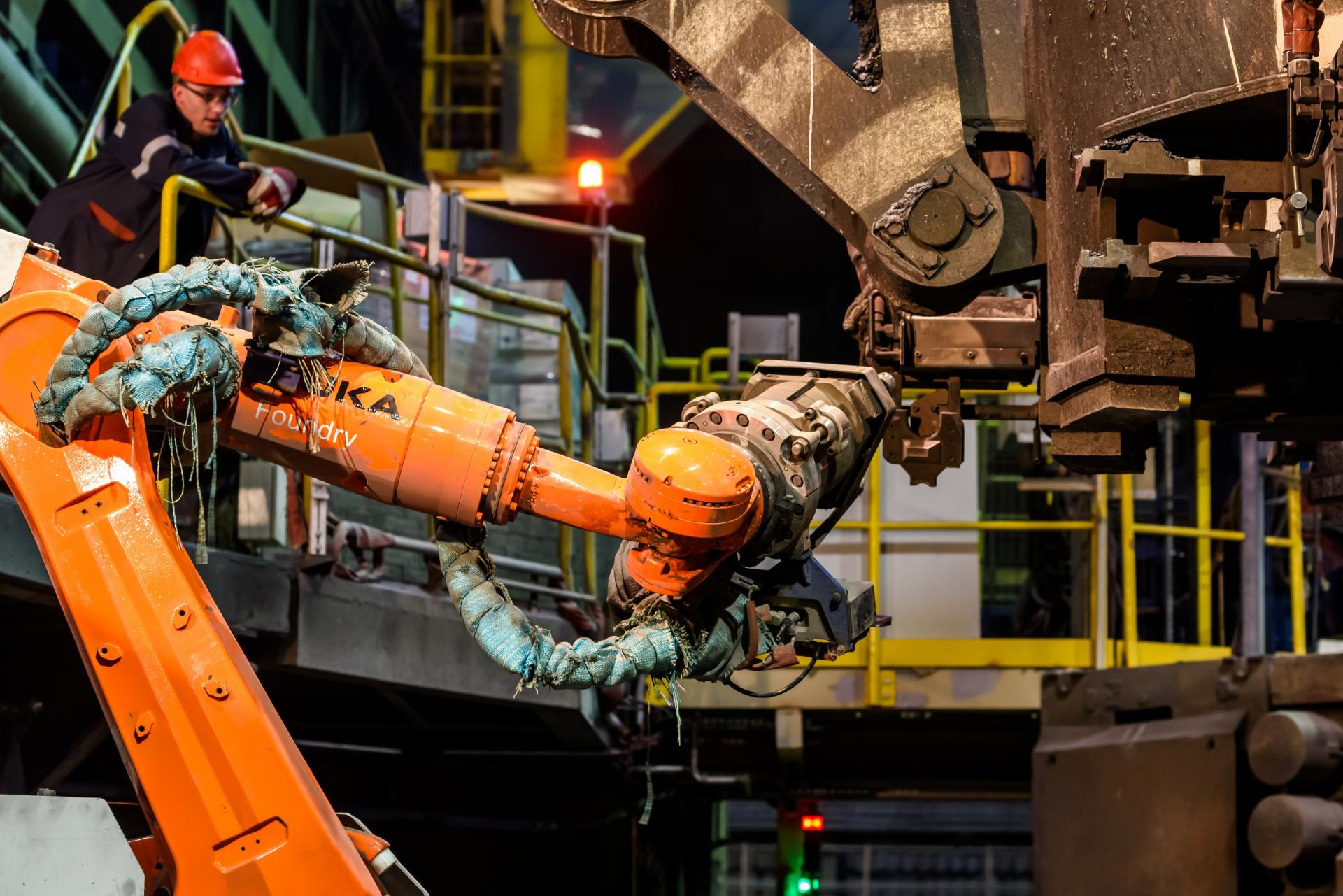
Two robotic systems installed by Vesuvius on the five-strand continuous casting machine will significantly improve workplace safety under these challenging operating conditions.“On the casting platform, employees previously had to manually inspect the tundish condition, handle covers and fittings, monitor steel flow, and measure temperature and hydrogen content, among other tasks. It was physically demanding, high-risk work performed in an environment of extreme temperatures, dust and noise, with the potential risk of contact with molten steel. Today, these tasks are performed by robots,” explains Roman Heide, CEO of Třinecké železárny, highlighting the benefits and rationale behind the investment. The automation has been implemented on one of the company’s two casting machines – the five-strand bloom caster capable of producing continuous cast products with diameters of up to 600 mm.
Each of the installed robots performs a specific role in the casting process. The RCT BKS (Robotic Casting Technology & Back Side) system is used for the automated handling of hydraulic cylinders on ladle slide gate systems. The second unit, RCT LP (Robotic Casting Technology & Ladle Platform), is a multifunctional robotic system designed for comprehensive tundish servicing on the casting platform.
“The robotic systems have taken over a number of routine and high-risk operations. These include collecting melt samples, measuring temperature, hydrogen content and steel level, applying insulating and refining slag to the steel surface, handling tundish equipment, and placing sealing rings,” says Miroslav Pszczolka, Member of the Board of Directors of Vesuvius Czech Republic. According to him, the main benefits include significantly improved employee safety, faster equipment replacement, reduced risk of human error, and a higher degree of automation. At the same time, the project represents a strategic response to generational workforce changes, with modern technologies helping to maintain stable production while making work in a three-shift operation more attractive.
The project was carried out by Vesuvius as part of the ongoing development of systems for its long-standing customer. The investment costs are offset by the longer service life of refractory ceramics achieved through the deployment of the robotic systems. “For Vesuvius, a supplier of refractory ceramics and automation solutions, this project confirms our role as a key partner of Třinecké železárny in achieving its production goals,” says Dino Galijašević, Commercial Director of Vesuvius Czech Republic, which has been supplying services and refractory ceramics to the Třinec steelworks for 30 years.
The key phase of the installation of both robots was carried out during last year’s overhaul of the continuous casting machine. “Subsequent commissioning and full integration of the technologies took place while production was already running under normal operating conditions. Successfully completing such a complex project without interrupting production demonstrates the thorough technical preparation and close cooperation between the Třinecké železárny implementation team and Vesuvius specialists,” says Tomáš Gajdzica, Production Director of Třinecké železárny. He acknowledged that completing the project while maintaining continuous production was exceptionally demanding.
Key benefits of robotisation
- Significant improvement in workplace safety
- Elimination of the risk of direct operator contact with molten steel
- Faster equipment replacement and maintenance interventions
- Higher precision and repeatability of operations
- Reduced risk of errors, incidents and production downtime
Continuous casting machines
Třinecké železárny operates two continuous casting machines. The first is a five-strand bloom caster, while the second is an eight-strand billet caster. The five-strand caster is capable of producing blooms with diameters of up to 600 mm.
Třinecké železárny – Moravia Steel
Telefon: +420 558 535 841
Mobiltelefon: +420 602 265 738
e-mail: Petra.Mackova@trz.cz